
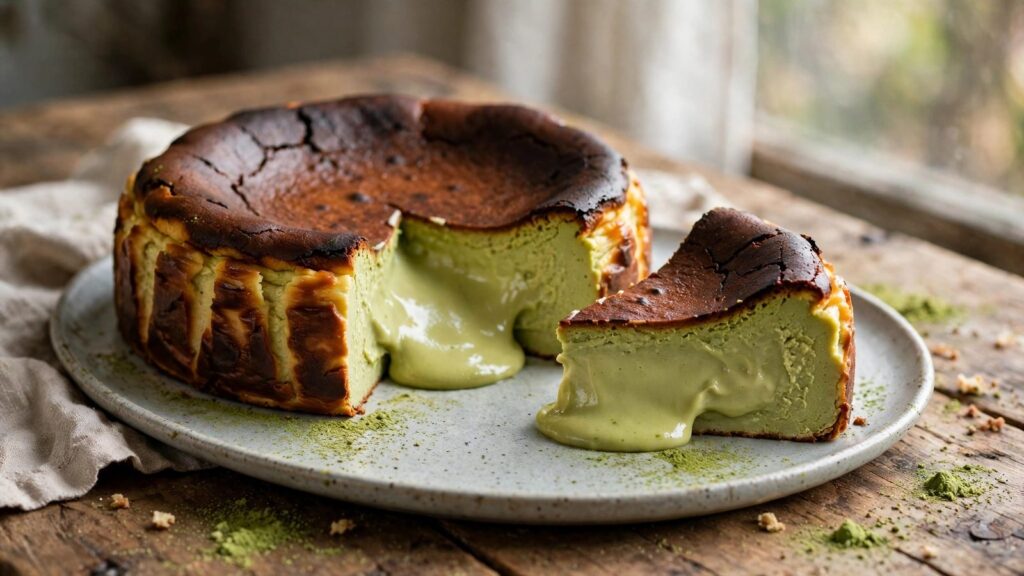
This matcha Basque burnt cheesecake is the viral bake everyone is slicing into right now: a deeply caramelised, almost-black top over a pale-green, custardy centre that stays soft and molten in the middle. It takes 15 minutes to mix, bakes in about 45, and needs no water bath, no crust and no fiddling.
I whisk the matcha into the batter first so the colour stays even and the flavour runs right through, instead of dusting it on at the end. The trick is pulling it out while the centre still wobbles like set jelly — that is what gives you the creamy, spoonable middle that makes Basque cheesecake famous.
Serve it barely warm or chilled overnight. Either way, the contrast between the bitter-sweet burnt top and the grassy, earthy matcha cream is what keeps people coming back for a second slice.
Ingredients
- 680 g (3 cups) full-fat cream cheese, at room temperature
- 200 g (1 cup) granulated sugar
- 4 large eggs, at room temperature
- 240 ml (1 cup) double cream (heavy cream)
- 30 g (1/4 cup) plain flour (all-purpose flour)
- 2 tbsp ceremonial-grade matcha powder, sifted
- 1 tsp vanilla extract
- 1/4 tsp fine sea salt
Instructions
- Heat the oven: Heat the oven to 220°C (425°F). Line a 20 cm (8-inch) springform tin with two crumpled sheets of baking paper, letting the paper rise 5 cm (2 inches) above the rim.
- Beat the base: Beat the cream cheese and sugar on medium speed for 2 minutes until completely smooth, scraping the bowl once. There should be no lumps at all.
- Add the eggs: Add the eggs one at a time, beating just until each disappears. Over-beating here traps air and makes the cake puff, then sink.
- Whisk in the matcha: Whisk the matcha into the cream, then pour the cream, flour, vanilla and salt into the bowl. Beat on low until the batter is silky and evenly pale green, about 30 seconds.
- Bake: Pour the batter into the tin and bake for 40-45 minutes. The top should be deeply browned, almost burnt in patches, and the centre should still wobble when you gently shake the tin.
- Cool and chill: Cool in the tin for 1 hour, then chill for at least 4 hours, or overnight. The centre firms to a soft, custardy set as it cools — do not cut it warm or it will run.
- Serve: Peel back the paper, slice with a hot, dry knife and dust lightly with extra matcha.
Tips for the best result
- Use ceremonial-grade matcha for a bright green colour and a smooth, grassy flavour; culinary matcha turns dull and bitter in the oven.
- Room-temperature cream cheese is non-negotiable — cold cheese leaves lumps that never bake out.
- If the top is browning too fast after 30 minutes, lay a loose sheet of foil over the tin.
- For a firmer, sliceable centre, bake 50 minutes; for the molten viral centre, stop at 40.
Storing and reheating
Cover and refrigerate for up to 5 days. It actually improves on day two. Freeze individual slices, well wrapped, for up to 1 month and thaw overnight in the fridge.
Frequently asked questions
Is a Basque cheesecake supposed to look burnt?
Yes. The deeply browned, almost-black top is the whole point of a Basque cheesecake. The high heat caramelises the sugars on the surface while the inside stays soft and custardy, and that bitter-sweet crust is what balances the rich filling.
Why is my matcha cheesecake brown instead of green?
The matcha was either low grade or mixed in unevenly. Use ceremonial-grade matcha, sift it first, and whisk it into the cream before adding it to the batter so the colour spreads evenly. Baking above 220°C (425°F) for too long will also dull the green.
Can I make matcha Basque cheesecake ahead of time?
Yes, it is better made ahead. Chill it for at least 4 hours and up to 2 days before serving. The texture sets as it cools, so the slices hold their shape and the centre stays creamy rather than runny.
Do I need a water bath for Basque cheesecake?
No. Basque cheesecake is baked without a water bath and without a crust, which is why it is so much easier than a classic cheesecake. The high oven heat and the tall baking paper are all it needs.
Can I use low-fat cream cheese?
I would not. Full-fat cream cheese is what gives the cake its creamy, custardy centre. Low-fat versions set rubbery and the cake cracks instead of staying soft in the middle.





Made this? Tell us how it went