
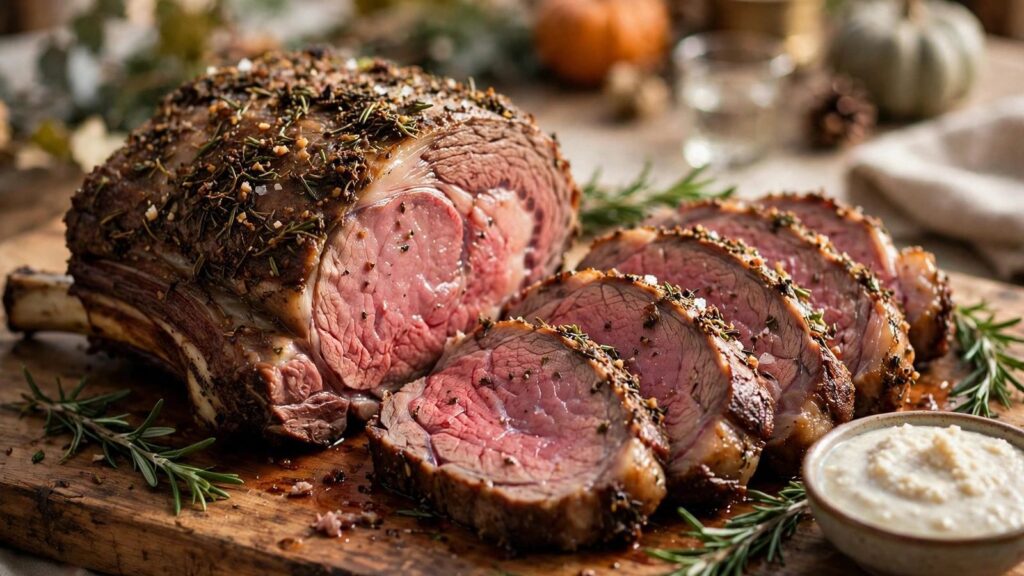
This prime rib recipe gives you a deeply browned, garlic-herb crust outside and a rosy, juicy medium-rare centre every time. The secret is a slow roast at 250°F (120°C) followed by a hot blast at the end, so the meat cooks evenly edge to edge instead of greying at the sides.
A 4-bone roast (about 8 lb / 3.6 kg) feeds eight generously and takes roughly 3 hours in the oven, plus a 30-minute rest that lets the juices settle. Serve it with creamy horseradish sauce and your favourite roast potatoes for a centrepiece that earns its place at Thanksgiving or Christmas.
I have cooked this roast the same way for years, and the thermometer is the one thing I never skip. Pull it at 120°F (49°C) for medium-rare and it will climb to a perfect 130°F (54°C) while it rests.
Ingredients
- 1 bone-in prime rib roast, 4 bones (about 8 lb / 3.6 kg)
- 2 tbsp (30 g) coarse kosher salt
- 2 tsp (10 g) freshly ground black pepper
- 6 cloves garlic, finely minced
- 3 tbsp (45 ml) olive oil
- 2 tbsp fresh rosemary leaves, finely chopped
- 1 tbsp fresh thyme leaves
- 1 tbsp Dijon mustard
For the horseradish sauce
- 1 cup (240 ml) sour cream
- 3 tbsp prepared horseradish, drained
- 1 tbsp lemon juice
- 1 tsp Dijon mustard
- 1/2 tsp kosher salt
- 1/4 tsp black pepper
Instructions
- Dry-brine overnight: Pat the roast completely dry with paper towels and rub it all over with the salt. Set it on a rack over a tray, uncovered, in the fridge for at least 12 hours and up to 24. The dry surface is what gives you a proper crust.
- Make the herb paste: Mix the garlic, olive oil, rosemary, thyme, Dijon and black pepper into a thick paste. Take the roast out of the fridge 1 hour before cooking and rub the paste over the top and sides.
- Slow roast: Heat the oven to 250°F (120°C). Place the roast bone-side down in a roasting pan and cook until a probe thermometer in the thickest part reads 120°F (49°C) for medium-rare, about 2¾ to 3 hours. Do not open the oven to check; trust the thermometer.
- Rest: Tent the roast loosely with foil and rest for 30 minutes. The temperature will climb to about 130°F (54°C) and the juices will redistribute. Do not slice early or the juices run out onto the board.
- Sear for the crust: Turn the oven up to 500°F (260°C). Uncover the roast and return it to the oven for 8 to 10 minutes, until the outside is dark and crackling. Watch it closely so the garlic does not burn.
- Carve and serve: Slice between the bones, then cut the eye into ½-inch (1.25 cm) slices. Stir the horseradish sauce ingredients together and serve alongside.
Tips for the best result
- Ask the butcher for a roast with the bones frenched and the chine bone removed, so carving is easy.
- For medium instead of medium-rare, pull the roast at 130°F (54°C); it will finish near 140°F (60°C).
- Save the bones: they make an excellent beef stock, and the meat between them is the best bite on the plate.
- Leftovers slice beautifully cold for sandwiches with horseradish sauce the next day.
Storing and reheating
Refrigerate leftover prime rib within 2 hours, wrapped tightly, for up to 3 days, or freeze slices for up to 2 months. Reheat gently in a 250°F (120°C) oven until just warm, about 15 minutes, so it does not overcook.
Frequently asked questions
How long does it take to cook a prime rib?
At 250°F (120°C), a 4-bone roast of about 8 lb (3.6 kg) takes roughly 2¾ to 3 hours to reach 120°F (49°C) for medium-rare, plus 30 minutes of resting and a 10-minute sear. Plan on about 20 minutes per pound at this low temperature.
What temperature should prime rib be cooked to?
Pull it from the oven at 120°F (49°C) for medium-rare, 130°F (54°C) for medium, or 110°F (43°C) for rare. Resting adds about 8 to 10°F, so the final serving temperature for medium-rare is around 130°F (54°C). A probe thermometer is the only reliable way to judge it.
Should prime rib be cooked bone-in or boneless?
Bone-in cooks more evenly and tastes better, because the bones insulate the meat and add flavour as it roasts. The bones also make a natural roasting rack. Boneless is easier to carve, but if you want the best result, choose bone-in and have the butcher remove the chine bone.
How long should prime rib rest before carving?
Rest it for 30 minutes, tented loosely with foil. This lets the juices settle back into the meat and lets the temperature rise to its final point. Slicing too soon leaves the juices on the board instead of in the meat.
What do you serve with prime rib?
Classic partners are creamy horseradish sauce, Yorkshire puddings or Parker House rolls, roasted potatoes, and a simple green vegetable like green beans or Brussels sprouts. A bold red wine such as Cabernet Sauvignon is the traditional pairing.


Made this? Tell us how it went