
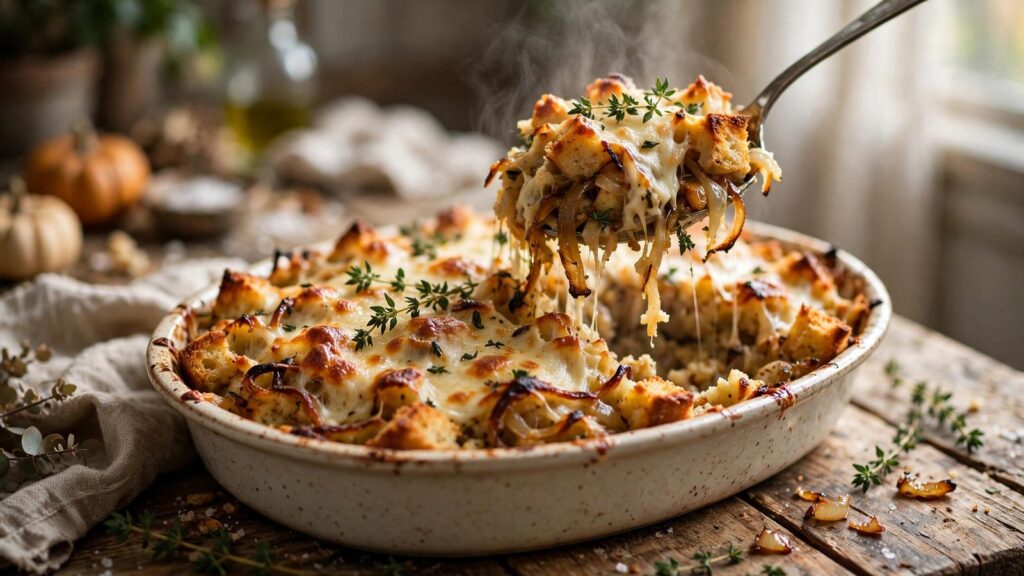
French onion soup and stuffing were always meant to meet. Slowly caramelised onions, nutty Gruyère and a splash of sherry turn ordinary bread cubes into the side dish everyone reaches for first at the Thanksgiving table.
The secret is patience with the onions. Forty minutes of slow cooking turns them jammy, sweet and deeply golden, and that flavour runs through every bite of the stuffing. The cheese on top goes bubbling and crisp at the edges.
This is one of the most-saved Thanksgiving sides of November for a reason: it is familiar enough for the traditionalists and just different enough to be the dish people ask about. It bakes in the same oven as the turkey, which helps too.
Ingredients
- 450 g (about 8 cups) day-old sourdough or French bread, cut into 2 cm cubes
- 60 g (4 tbsp) unsalted butter
- 3 large yellow onions (about 700 g), thinly sliced
- 1 tsp fine sea salt
- ½ tsp black pepper
- 1 tsp fresh thyme leaves, plus extra to serve
- ½ tsp dried sage
- 350 ml (1½ cups) chicken or vegetable stock
- 2 large eggs
- 200 g (2 cups) grated Gruyère cheese
- 50 g (½ cup) grated Parmesan cheese
To serve
- Fresh thyme leaves
- Extra grated Gruyère
Instructions
- Dry the bread: Heat the oven to 190°C (375°F). Spread the bread cubes on a baking tray and toast for 8–10 minutes until dry and lightly golden at the edges. Tip into a large bowl.
- Caramelise the onions: Melt the butter in a large pan over medium heat. Add the onions and salt, then cook for 35–40 minutes, stirring every few minutes, until they are soft, jammy and deep golden brown. Stir in the thyme, sage and black pepper.
- Combine: Pour the stock over the toasted bread and toss gently. Add the caramelised onions, the beaten eggs and half the Gruyère and Parmesan, and fold everything together until the bread is evenly moistened.
- Bake covered: Tip into a buttered 23 x 33 cm (9 x 13 inch) baking dish, cover tightly with foil and bake for 25 minutes, until heated through and set.
- Brown the top: Remove the foil, scatter over the remaining Gruyère and Parmesan, and bake uncovered for 15–20 more minutes until the top is bubbling, golden and crisp at the edges. Rest for 10 minutes before serving, scattered with fresh thyme.
Tips for the best result
- Keep the heat at medium or below while the onions cook. If they start to catch, add a tablespoon of water and turn the heat down.
- Use a firm, chewy bread such as sourdough: soft sandwich bread turns to mush.
- For extra French onion flavour, add a splash of dry sherry to the onions in the last 5 minutes of cooking.
Storing and reheating
Refrigerate leftovers in an airtight container for up to 3 days. Reheat covered in a 180°C (350°F) oven for 15 minutes, then uncover for 5 minutes to re-crisp the top. It also freezes well for up to 1 month; thaw overnight in the fridge before reheating.
Frequently asked questions
Can I make French onion stuffing ahead?
Yes. Assemble it the day before, cover and refrigerate, then add 10 extra minutes to the covered bake. Bring it to room temperature for 30 minutes first.
What bread works best?
Day-old bread is ideal because it soaks up the stock without falling apart. If your bread is fresh, cube it and dry it in a 150°C (300°F) oven for 10 minutes.
Can I make it vegetarian?
Yes. Use a good vegetable stock and a vegetarian Gruyère-style cheese. The caramelised onions carry most of the flavour, so it still tastes rich.
Can I add wine to the onions?
It is not traditional, but a splash of white wine in the onions is lovely. Add it after the onions have softened and let it bubble away before adding the stock.




Made this? Tell us how it went